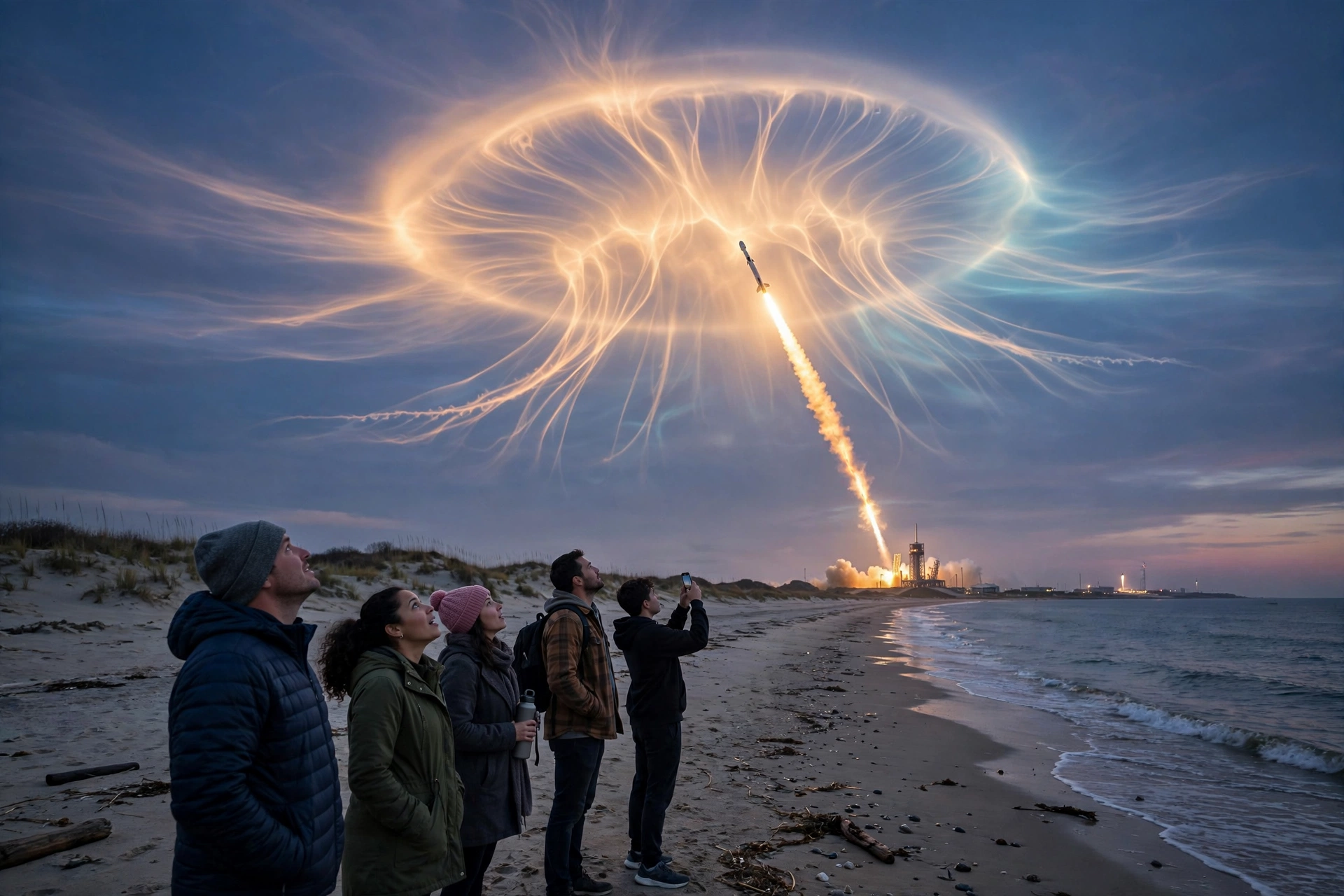
Early risers and evening sky watchers along the US east coast were treated to an extraordinary sight this week, as a SpaceX rocket launch produced a glowing, tentacled cloud that spread across the twilight sky like a giant jellyfish. Photos shared widely online, and reported by The Guardian, showed a luminous plume blooming high above the horizon — bright enough to stop commuters in their tracks and flood social media with questions about what, exactly, people were looking at.
What Is a Jellyfish Cloud?
The phenomenon, often called a space jellyfish, happens when a rocket launches shortly before sunrise or shortly after sunset. On the ground, the sky is already dark, but high in the upper atmosphere the rocket’s exhaust plume is still bathed in sunlight. As the plume expands in the thin air, it fans out into a wide, translucent shape — a bright “head” with trailing tendrils — that glows against the darkening sky below.
There is nothing mysterious about the physics, even if the result looks otherworldly. At extreme altitude, exhaust gases expand much further than they would near the ground, and the sun’s low angle lights them from the side. The effect has been recorded after launches from Florida and California for years, but each occurrence still surprises people who happen to be looking up at the right moment, because the cloud can appear suddenly, hang in the sky for minutes and change shape as upper-level winds stretch it out.
Why This One Drew So Much Attention
Timing and geography made this display especially visible. A launch window that placed the rocket’s climb over the east coast during twilight meant millions of people were outdoors, commuting or simply able to see the horizon at exactly the right moment. Clear skies across a long stretch of coastline did the rest. Within minutes, the same glowing shape was being photographed from beaches, suburbs and city rooftops hundreds of miles apart.
Events like this have become an unexpected public dividend of the modern launch cadence. With companies such as SpaceX flying far more often than the space agencies of a generation ago, phenomena that were once rare curiosities for aerospace insiders are now shared national experiences — the kind of moment that gets families outside together, much like the spirit behind our story on community volunteers preparing families for winter, where neighbours showing up for one another turned an ordinary week into something memorable.
A Teaching Moment in the Sky
Scientists and educators are quick to seize on jellyfish clouds because they make invisible physics visible. The display demonstrates how sunlight, altitude and atmospheric pressure interact — concepts that can feel abstract in a classroom but become obvious when a glowing plume hangs over your own street. Astronomy groups often report spikes in interest after such events, with children in particular asking the best possible question: why does it look like that?
The launch itself was part of the steady rhythm of commercial spaceflight that now supports communications, weather forecasting and research. Our coverage of using AI tools to learn more effectively made a similar point about technology in everyday life: tools that once belonged only to specialists are now shaping ordinary routines, from exam preparation to the view above the evening sky.
How to Catch the Next One
If you missed this display, there will be other chances. The best odds come with launches scheduled in the hour before dawn or the hour after dusk, viewed from a spot with a clear, dark horizon and minimal light pollution. Launch providers publish schedules in advance, and local astronomy clubs usually flag promising twilight windows. Give your eyes a few minutes to adjust, look towards the launch direction, and keep a phone ready — the brightest phase of the plume often lasts only a few minutes.
Above all, it is worth simply looking up. The jellyfish cloud over the east coast was not an anomaly or a warning sign; it was sunlight catching a rocket’s trail at exactly the right angle, and a reminder that even in an age of constant launches, spaceflight can still make an entire coastline stop and stare.
2 thoughts on “SpaceX Launch Creates Stunning Jellyfish Cloud Over US East Coast”