Saturn’s retinue has grown dramatically. Astronomers have confirmed 128 new moons around the ringed planet, raising its recognised total to 274, the highest of any planet in the solar system. The confirmations, accepted by the International Astronomical Union, draw on a survey conducted with the Canada-France-Hawaii Telescope and on orbit verification work involving researchers from the University of British Columbia. The newly catalogued moons are small, distant and irregular, and most had appeared only as tentative candidates in earlier data before painstaking follow-up observations secured their status.
Technique Matters More Than Luck
Discoveries of this kind are products of method. The survey team accumulated deep images of the region around Saturn across several years and combined them using a shift-and-stack approach aligned with the motion of Saturnian moons. That processing suppresses background stars and lifts genuine satellites above the detection threshold. Because a moon must be observed over a sufficiently long arc before its orbit can be trusted, the team returned repeatedly to promising candidates. Only when predictions based on early sightings matched later positions exactly was each object submitted for formal recognition as a moon.
Saturn 274, Jupiter 95
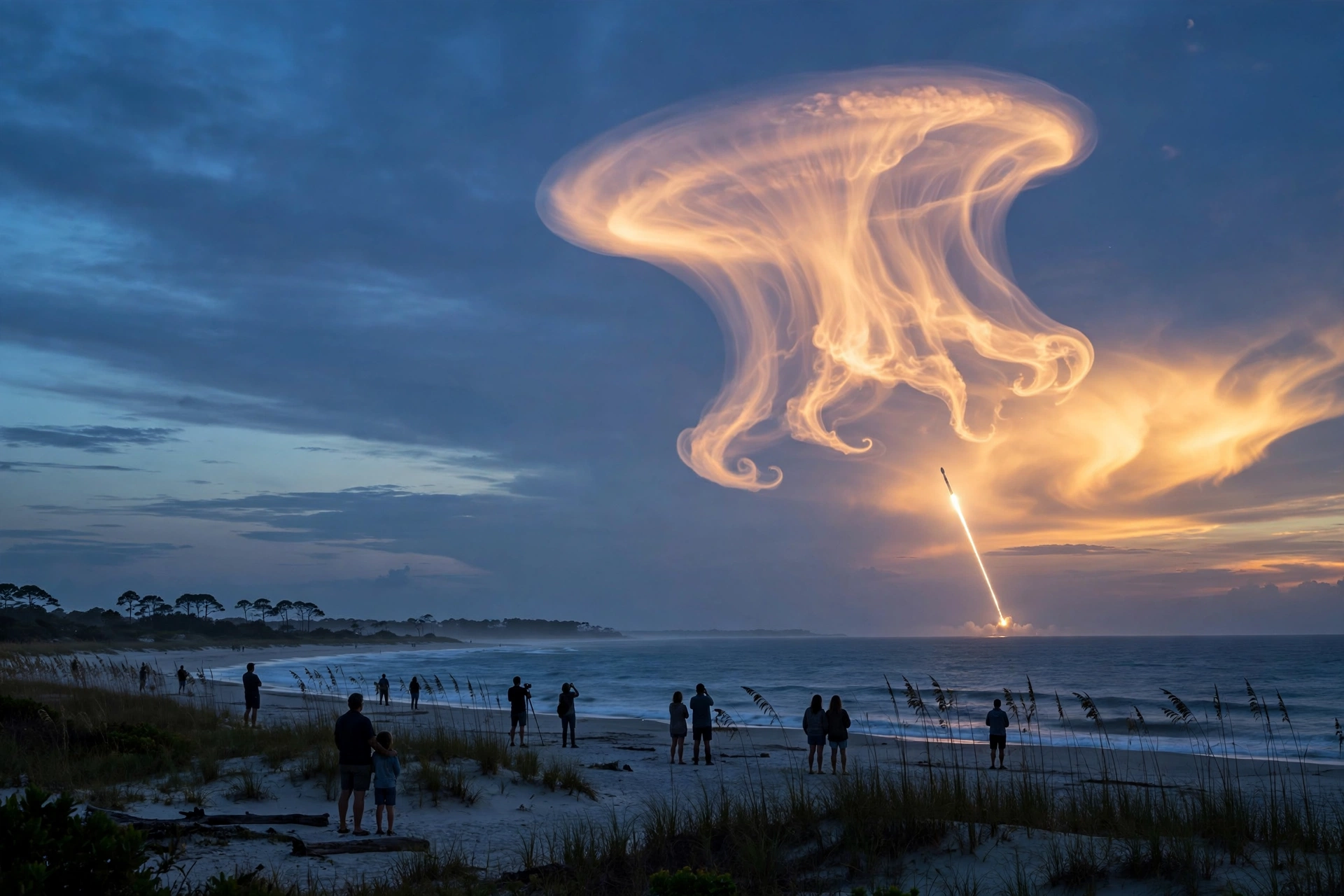
The comparison with Jupiter is stark. With 95 confirmed moons, Jupiter now trails Saturn by 179, and astronomers consider it implausible that enough large undiscovered Jovian moons remain to alter that picture. The two planets traded the lead repeatedly while surveys were sensitive only to bigger objects; deeper surveys around Saturn kept finding more. Regular readers may contrast this slow-burn discovery with the instant spectacle described in our account of a SpaceX launch lighting up the east coast sky; both, in their way, show how observation turns into knowledge.
Debris Fields With a Story to Tell
Most of the new moons move in families, groups whose members share orbital characteristics too similar to be coincidence. The accepted interpretation is collisional: a captured parent moon was shattered, and its fragments have been drifting along related paths ever since. Dating those families helps planetary scientists estimate how frequently destructive collisions still occur among outer solar system bodies. The University of British Columbia notes that confirming the find required international cooperation, since no single observatory enjoys enough clear nights in a season to track every candidate through to certainty.
Names, Catalogues and Long-Term Value
Once recognised, a moon enters the permanent catalogue with a provisional designation, and many of Saturn’s irregular moons eventually receive names drawn from mythological traditions, including Norse, Inuit and Gallic figures. The catalogue is more than bookkeeping. Precise orbits let theorists run the Saturn system backwards in computer simulations, testing how captured objects settled, collided and scattered over immense spans of time. Every additional well-measured moon sharpens those simulations, which is why astronomers invest years in objects that will never be visible to the public and may never be visited by any spacecraft.
Not the Last Word on Saturn
The team behind the survey is the first to say the census remains incomplete at the smallest sizes. Moons under roughly a kilometre across are still largely beyond reach, and future instruments will probe that regime around Saturn first, given how productive the planet has proved. Even so, 274 is a landmark figure achieved through persistence and international teamwork. It also carries a quiet lesson for science generally: some of the most solid facts we possess were assembled one faint, easily missed observation at a time, by people willing to check their work for years before claiming success.
Historical Perspective: From Galileo to 274
When Galileo Galilei first observed Saturn in 1610, he could not even resolve its rings, mistaking them for companion planets. Titan was identified in 1655, and for more than two centuries the known family grew by single moons, each a notable event. The photographic era quickened the pace, spacecraft visits added close-range finds, and digital surveys have now turned discovery into catalogue-scale work. The jump to 274 would have been unimaginable to the astronomers who celebrated finding a ninth moon in 1899. Yet the method’s spirit is unchanged: look carefully, record honestly, and let others verify. Four centuries on, Saturn continues to reward exactly that discipline more generously than any other planet we know of today.
1 thought on “Astronomers Confirm 128 More Moons of Saturn, Total Now 274”