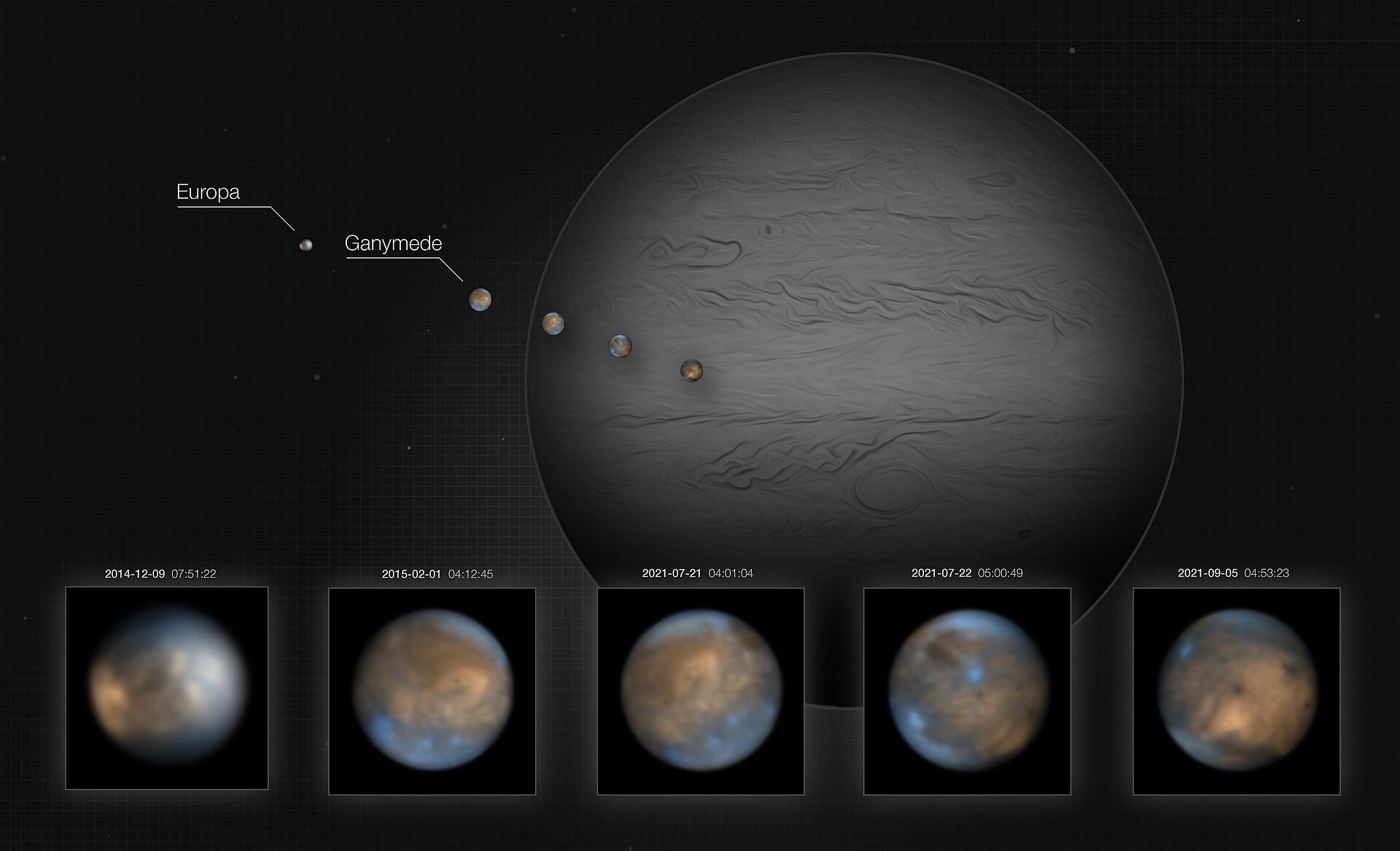
Ganymede, the largest moon in the solar system, almost certainly hides a global ocean beneath its icy crust, but new modelling suggests that ocean may be so deep that its floor is not rock at all. Under the crushing pressure at the bottom of an ocean perhaps hundreds of kilometres deep, water can freeze into dense forms of ice that sink rather than float, creating a layered world: liquid sandwiched between ice above and exotic ice below. That arrangement matters enormously for habitability, because on Earth the contact between ocean water and rocky seabed drives chemical reactions that supply energy for life. If Ganymede’s ocean is sealed off from rock by a thick ice layer, nutrients and chemical energy would have to arrive by slower routes, perhaps carried down through the ice shell over geological time. The models depend on the moon’s exact internal structure, which a European spacecraft now en route to the Jupiter system is designed to measure, using gravity, magnetic fields and radar to separate the contributions of ice, water and rock. Its magnetometer is especially valuable, because Ganymede uniquely generates its own magnetic field, and the ocean’s response to Jupiter’s field adds a detectable signature that reveals the ocean’s depth and saltiness.
What the Evidence Shows
Scientists are careful to keep the possibilities open, because a layered ocean does not make Ganymede lifeless, only different. Some calculations suggest that at certain depths and pressures, the boundary between liquid and high-pressure ice may permit exchange, or that the ice floor itself could host briny pockets where chemistry concentrates. Laboratory experiments that recreate these pressures are testing how salts and gases behave in such exotic ice, giving the spacecraft team predictions to check when data arrives in the next decade. Comparison with Europa and Callisto, Ganymede’s neighbouring ocean worlds, sharpens the questions: three moons, three different ocean architectures, and potentially three different prospects for life. That natural experiment is one reason the Jupiter system draws so much mission interest. Understanding Ganymede also informs the interpretation of distant exoplanets, where water worlds with deep oceans may be common and the same high-pressure ice could govern their interiors. For now, the moon keeps its secret behind hundreds of kilometres of ice and water. What has changed is the quality of the questions, which have moved from whether an ocean exists to how it is built, how it exchanges energy and whether anything could live within it. Reporting and analysis from sources such as NASA track the same developments, and specialists following the deep ocean of Ganymede say the direction is now consistent across independent lines of evidence.
The Wider Context
Funding bodies are watching the deep ocean of Ganymede closely because the work sits at the junction of basic curiosity and practical return. Grant panels increasingly ask for a path from discovery to application, while researchers push back that the most valuable uses of fundamental science are rarely the ones written into the original proposal. The tension is productive when both sides stay honest about timescales.
What Happens Next
The long view on the deep ocean of Ganymede is that fields advance by accumulation rather than by single announcements. This result adds a solid, checkable piece to a structure many teams are building, and its authors have shared their data so the piece can be tested from every side. That is how the picture eventually becomes reliable enough to act on. You can follow related developments in our coverage of science.